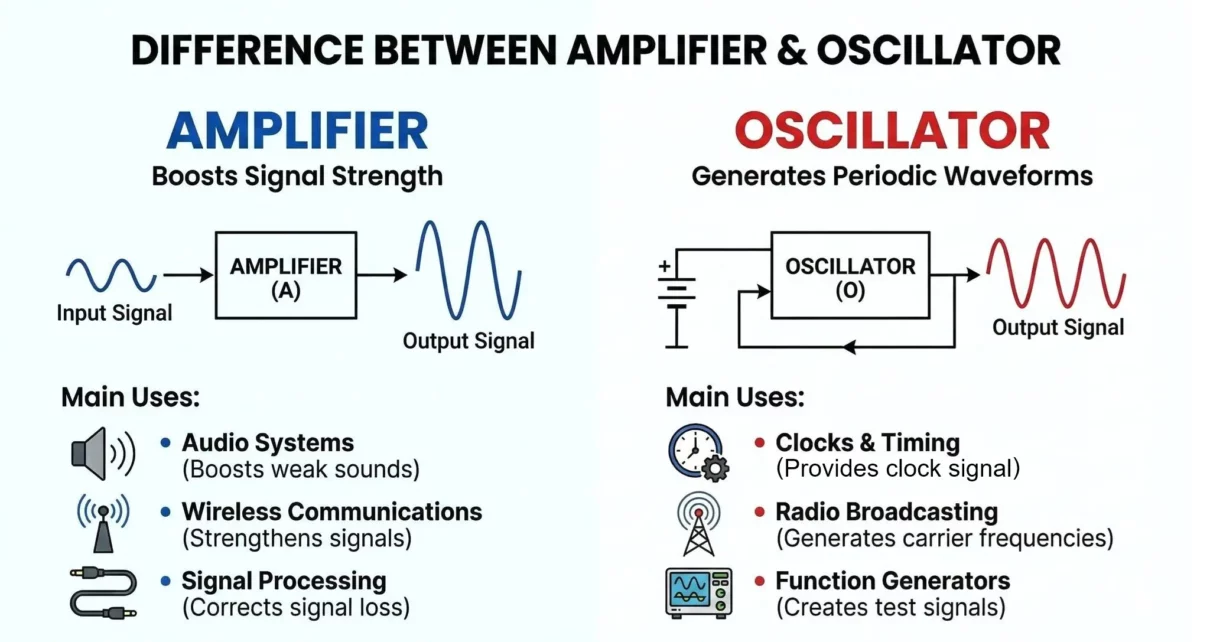
In electronic systems, signals are often required to be either strengthened or generated. Two fundamental circuits that perform these roles are the amplifier and the oscillator.
An amplifier is an electronic circuit designed to increase the amplitude of an input signal without significantly altering its shape. It takes a weak signal (such as from a microphone or sensor) and produces a stronger output signal.
An oscillator, on the other hand, is a circuit that generates a continuous periodic signal (such as sine wave, square wave, or triangular wave) without requiring an external input signal.
Block Diagram Explanation
Amplifier Block Diagram
Amplifiers are essential in signal processing, communication, and audio systems, where weak signals need boosting.
Basic blocks:
- Input Signal Source
- Provides weak signal
- Amplifying Device
- Transistor / Op-Amp
- Controls large output using small input
- Power Supply
- Provides energy for amplification
- Output Load
- Receives amplified signal
- Feedback (Optional)
- Negative or positive for output control
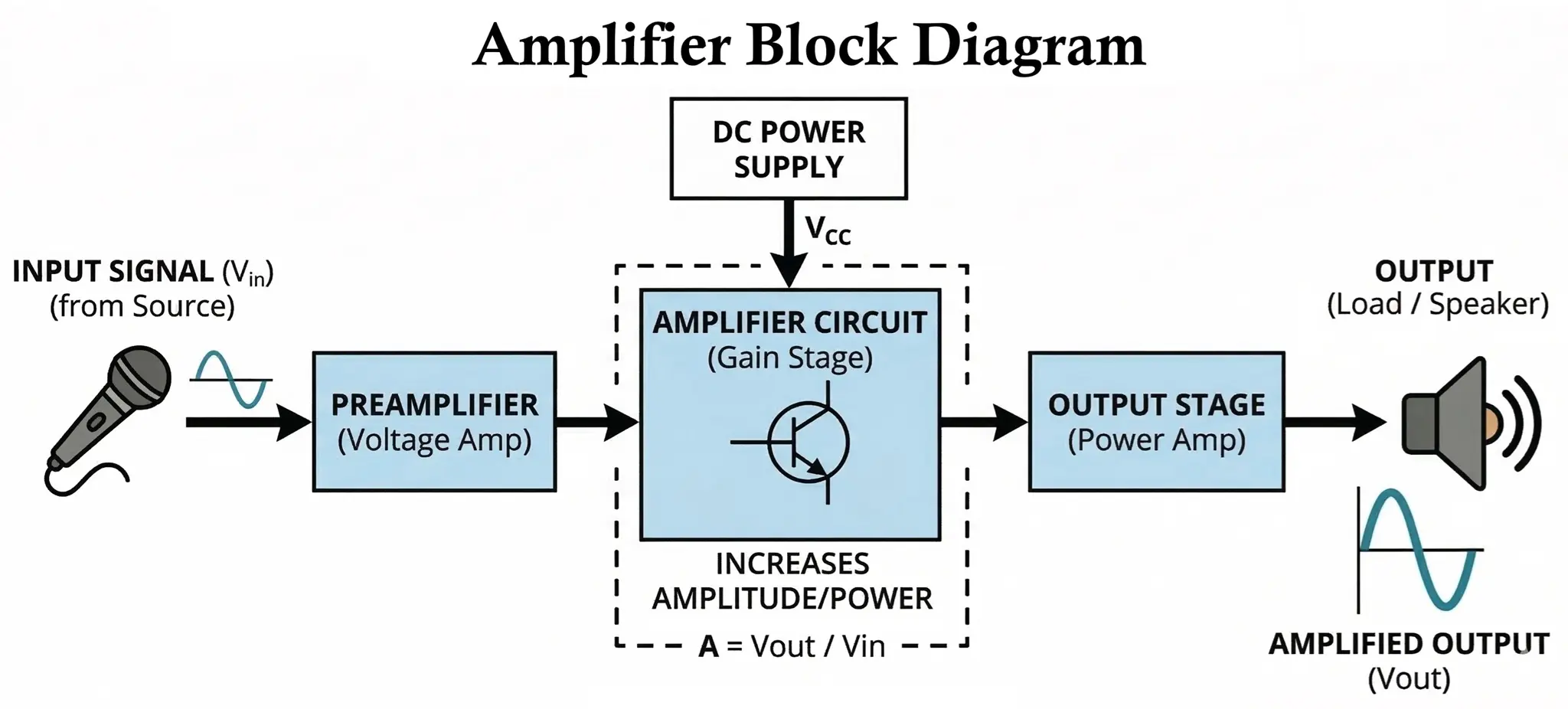
Flow: Input Signal → Amplifier → Output Signal (Amplified)
- No input signal = No output
Oscillator Block Diagram
Oscillators are critical in timing circuits, frequency generation, and signal transmission systems.
Basic blocks:
- Amplifier Stage
- Provides gain
- Feedback Network
- Returns part of output to input
- Frequency Determining Network
- RC / LC / Crystal components
- Power Supply
- Provides DC energy
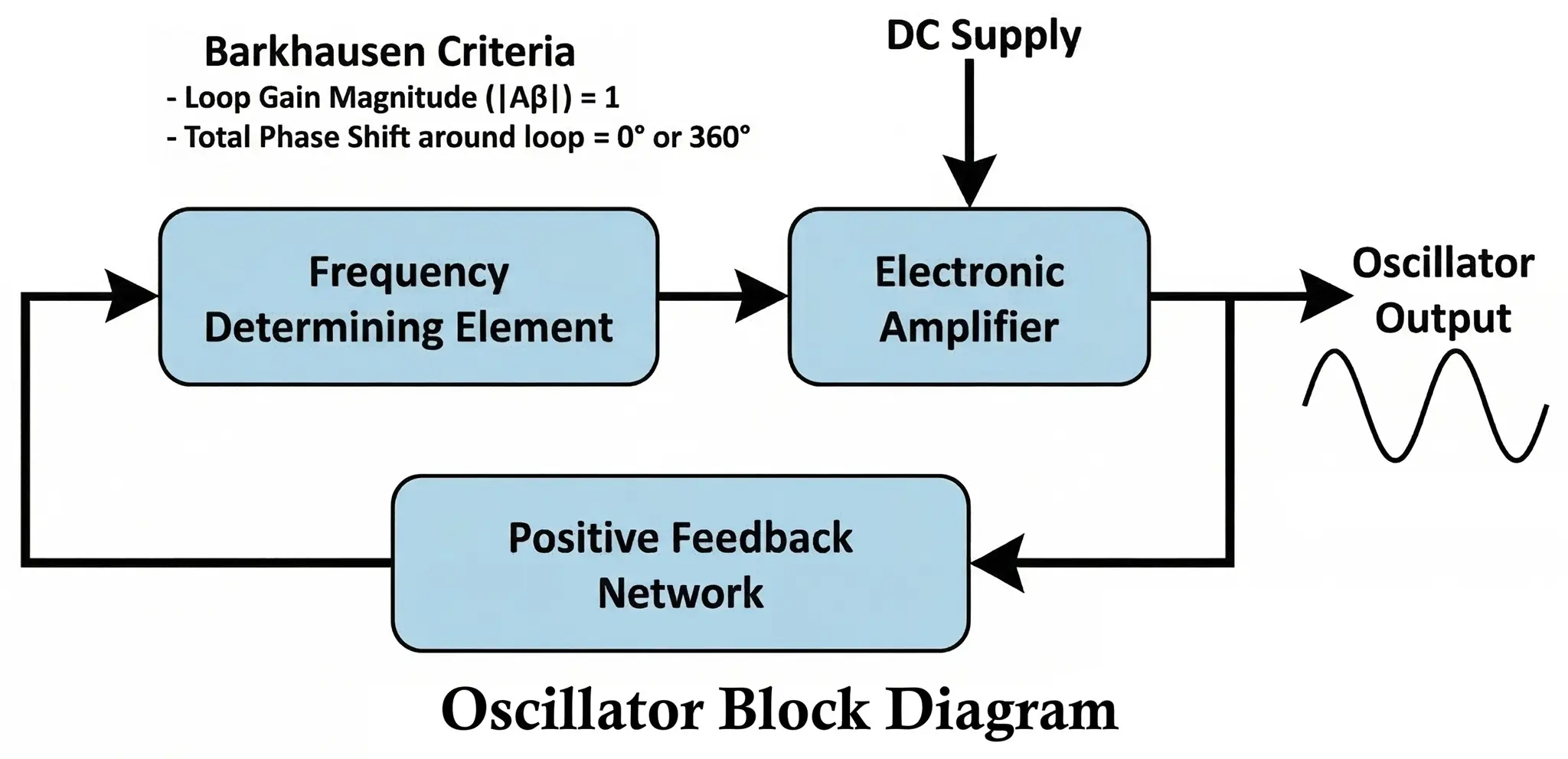
Flow: Output → Feedback → Frequency Network → Amplifier → Output
- No external input needed
- Feedback sustains oscillations
Working Principle
Working of an Amplifier
An amplifier operates based on the principle of energy conversion and signal control.
- It uses an external power supply to increase the amplitude of the input signal.
- The input signal controls a larger flow of energy from the power source.
- The output is a magnified version of the input signal.
Key Concept: Amplifier does not create a signal – it only strengthens an existing one.
Example: If a small AC signal of 10 mV is applied to an amplifier with gain 100: Output = 10 mV × 100 = 1 V
- Gain (A) = Output / Input
- Can be voltage gain, current gain, or power gain
- Must maintain linearity to avoid distortion
Working of an Oscillator
An oscillator works on the principle of positive feedback and energy exchange.
- It generates signals without any external input signal
- Uses a feedback network to sustain oscillations
- Converts DC power into an AC signal
Key Concept: Oscillator creates its own signal using feedback.
Barkhausen Criterion: A circuit oscillates when the loop gain equals unity (|Aβ|=1) and the total phase shift around the loop is 0° or 360°.
- For sustained oscillations:
- Loop Gain = 1
- Total Phase Shift = 0° or 360°
Example: An RC oscillator produces a sine wave using resistors and capacitors that continuously charge and discharge.
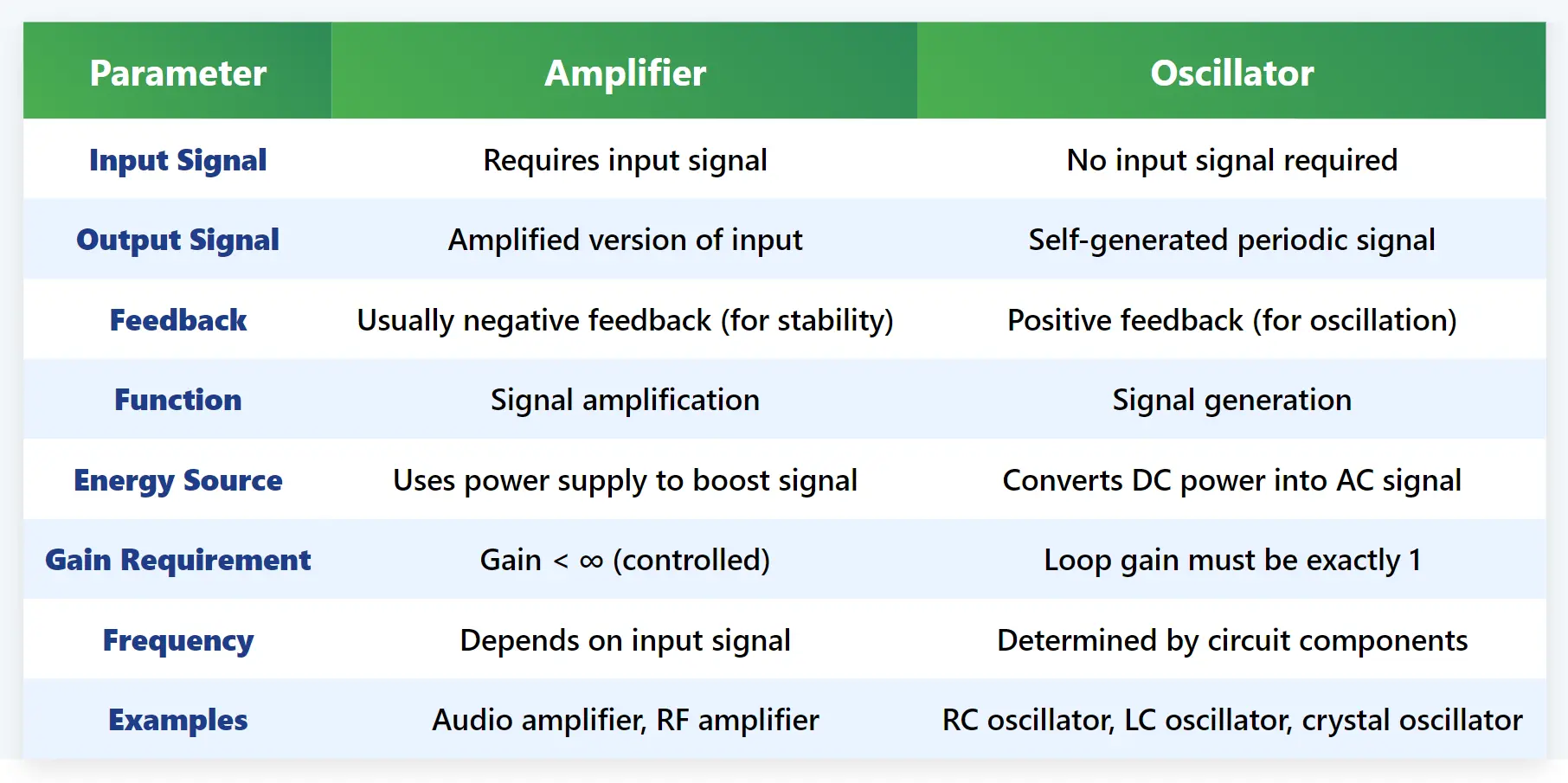
Difference Between Amplifier and Oscillator
| Parameter | Amplifier | Oscillator |
|---|---|---|
| Input Signal | Requires input signal | No input signal required |
| Output Signal | Amplified version of input | Self-generated periodic signal |
| Feedback | Usually negative feedback (for stability) | Positive feedback (for oscillation) |
| Function | Signal amplification | Signal generation |
| Energy Source | Uses power supply to boost signal | Converts DC power into AC signal |
| Gain Requirement | Gain < ∞ (controlled) | Loop gain must be exactly 1 |
| Frequency | Depends on input signal | Determined by circuit components |
| Examples | Audio amplifier, RF amplifier | RC oscillator, LC oscillator, crystal oscillator |
Types
Types of Amplifiers
Amplifiers are classified based on function and operation:
- Voltage Amplifier
- Increases voltage level
- Used in early signal stages
- Example: Small-signal transistor amplifier
- Current Amplifier
- Increases current
- Used in current-sensitive applications
- Power Amplifier
- Increases both voltage and current
- Used to drive loads like speakers
- Operational Amplifier (Op-Amp)
- High gain differential amplifier
- Used in filtering, integration, and signal conditioning
- RF Amplifier
- Amplifies high-frequency signals
- Used in communication systems
Types of Oscillators
Oscillators are classified based on frequency-determining components:
- RC Oscillators
- Use resistors and capacitors
- Suitable for low frequencies
- Examples:
- Wien Bridge Oscillator
- Phase Shift Oscillator
- LC Oscillators
- Use inductors and capacitors
- Suitable for high frequencies
- Examples:
- Hartley Oscillator
- Colpitts Oscillator
- Crystal Oscillators
- Use quartz crystal
- Very high frequency stability and accuracy
- Used in clocks and microcontrollers
- Relaxation Oscillators
- Generate non-sinusoidal waves (square, triangular)
- Example: 555 timer oscillator
Advantages and Disadvantages
Amplifiers
Advantages
- Increases weak signals for better processing
- Essential for communication systems
- Improves signal strength without changing waveform
- Can be designed for specific frequency ranges
Disadvantages
- Introduces noise and distortion
- Requires careful biasing and design
- Efficiency can be low (especially power amplifiers)
- Heat dissipation issues
Oscillator
Advantages
- Generates signals without external input
- Provides stable frequency (especially crystal oscillators)
- Essential for timing and synchronization
- Simple circuits can produce reliable outputs
Disadvantages
- Frequency drift due to temperature and component variation
- Requires precise design for stability
- Harmonic distortion in some oscillator types
- Startup conditions must be satisfied
Applications
Amplifiers
- Audio Systems (microphones, speakers)
- Radio and TV Communication
- Signal Processing Circuits
- Instrumentation Systems
- Medical Devices (ECG, EEG amplifiers)
- Wireless Communication Systems
Oscillators
- Clock Generators in digital circuits
- RF Signal Generation in transmitters
- Function Generators
- Microcontroller Timing Circuits
- Switching Power Supplies
- Radar and Communication Systems
Conclusion
Amplifiers and oscillators are two foundational building blocks in electronics, but they serve fundamentally different purposes.
- An amplifier is used to increase the strength of an existing signal, making it suitable for further processing or transmission.
- An oscillator is used to generate a new signal without any external input, relying on feedback and energy conversion.
The key distinction lies in:
- Amplifier → Signal Boosting
- Oscillator → Signal Generation
Understanding this difference is crucial for designing circuits in communication systems, signal processing, embedded systems, and power electronics.
In practical systems, both are often used together, for example, an oscillator generates a carrier signal, and an amplifier boosts it for transmission. This synergy highlights their complementary roles in modern electronics.
Different Types of Oscillators with Working and Applications
TDA2030 Audio Amplifier Circuit: Mono, Stereo and Bass Amplifier