
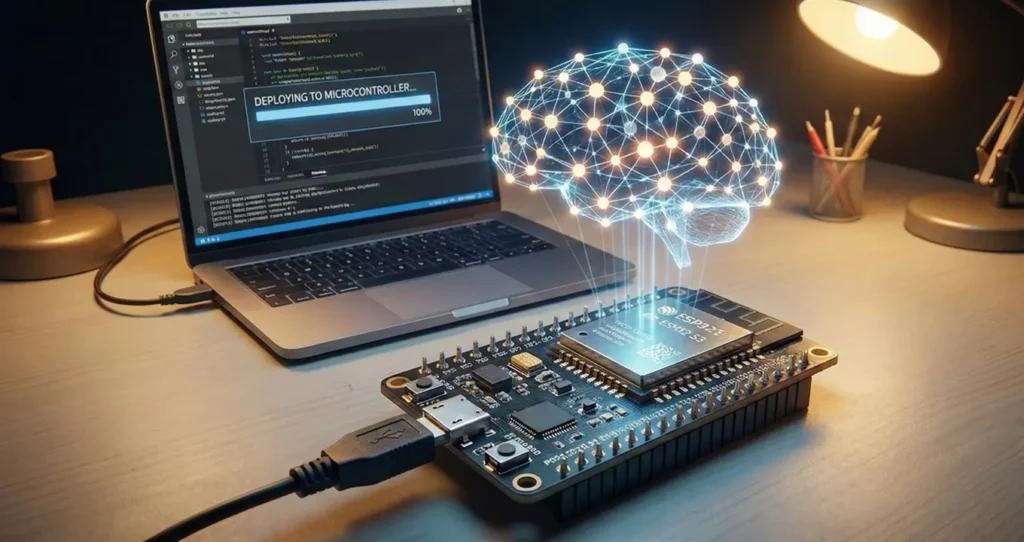
Running neural networks on microcontrollers once appeared impractical. It is now a major component of embedded design. TinyML and enhanced tooling have enabled developers to place intelligence on low-power edge devices directly.
Microcontrollers are highly restrictive systems. They provide low RAM, minimal flash memory, low processing speed, and constrained power envelopes. Conventional neural networks are designed to run on GPUs and other large processors, and they typically require extensive optimization before execution. The aim is straightforward yet challenging; minimize size and computation while maintaining reasonable accuracy.
Why On-Device Inference Matters
Putting AI directly on a device provides immediate benefits. Latency drops because there is no need to transmit data to a server and wait for an answer. Privacy is also enhanced because raw sensor data can remain local. This saves bandwidth, cloud expenses and enables the systems to continue operating even in the absence of the internet.
These advantages make edge AI useful in many products. Voice triggers in smart home devices, gesture recognition in wearables, and anomaly detection in industrial sensors are all examples where small, fast models running locally are more practical than cloud-based processing.
Understanding MCU Constraints
Before deploying a model, engineers must design around strict hardware limits. Memory is the first challenge. Model parameters must fit into flash, and intermediate data must fit into RAM during inference. Even a slightly oversized model can crash a system. This is especially critical for electronics as components are continuously shrinking.
Processing power is another barrier. Most MCUs do not include powerful floating-point hardware, so standard deep learning tasks run slowly. Power usage is also an important issue, particularly for battery-powered devices that need to operate for long periods. Another layer of complexity is real-time performance, as some applications need answers in milliseconds.
Techniques for Model Optimization
The most significant step is often quantization. Converting 32-bit floating-point values into 8-bit integers can save memory and accelerate computation with only a small loss of accuracy. Further pruning can reduce the size of a model by eliminating less significant weights and connections.
It is also necessary to choose lightweight architectures that are optimized to be used in an embedded setting. Compact convolutional networks with depth wise separable layers for example. Knowledge distillation can help train a small model to behave like a larger, more precise one in certain projects. An understanding of digital logic families is useful here.
Tools That Make Deployment Easier
Special frameworks assist in the bridging of gaps between machine learning and embedded systems. TensorFlow Lite on Microcontrollers can convert trained models to efficient embedded code. CMSIS-NN offers optimized ARM Cortex-M processor neural network kernels to enhance the speed of inference and energy consumption.
End-to-end platforms such as Edge Impulse enable data collection, model training, optimization, and firmware export simpler. These kits facilitate quicker development and allow TinyML to be accessible to all engineers. Not just AI experts.
Typical Deployment Workflow
The typical workflow begins with training models on a desktop or cloud computer. Quantization, pruning, and architecture tuning are used to optimize the model after training. The optimized code is then translated into an embedded-friendly format and incorporated into firmware.
Once deployed to hardware, profiling begins. Developers measure RAM usage, flash usage, and inference time, and adjustments follow soon after. This is also where choosing an edge AI MCU becomes important, since different microcontrollers offer different memory sizes, instruction sets, and hardware acceleration features.
Real-World Example: Keyword Spotting
A common TinyML application is always-on keyword detection. A microphone streams audio to an MCU, which processes short sound frames and runs a compact neural network to detect a wake word. The system responds instantly and works offline. Power use stays low because heavier processing only happens when the keyword is recognized.
Endnote
Edge AI combines efficient hardware design with compact machine learning models. It builds on traditional embedded knowledge while expanding the role of artificial intelligence. As tools mature and hardware continues to improve, running neural networks on resource-constrained MCUs will become a standard feature of next-generation embedded systems.
Artificial Intelligence in Electronics: From Design to Production
Beyond the Pixel: The Definitive Guide to the Dell Monitor Ecosystem